It’s a bit of a mess, really. A beautiful, normal-mapped mess. A horror-shooter where you carry a dozen weapons on your person all at once — but can’t stick a flashlight on the end of any of ’em.
That paradox is emblematic of id Software’s Doom 3. It wants you to charge head-first into the forces of darkness with a middle finger to the sound of its heavy-rock anthem — a call to suit up and sit down at your PC. Yet it wants you to fear that darkness and be weary of what lurks beneath, to be just some guy with a dodgy flashlight battling terrible foes from another dimension.
It’s a meal with decent ingredients but you don’t know how to feel about it because you don’t know what the damn recipe’s supposed to be.
It’s easy to see why bringing Doom into 2004 was going to be a Hellish feat. A generational leap that demanded id transpose its genre-defining, industry-defining legacy into a cutting-edge engine, transposing sprites into an era where shooters largely aspired to life-like visuals when contemporaries like Half-Life and Halo didn’t have such a colourful legacies to maintain. They had to do what they did before but with more polygons.
Doom didn’t have that luxury.

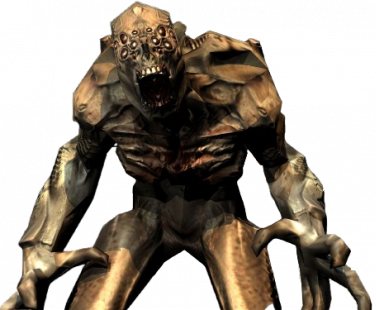
It’s hard not to see id’s efforts as a gritty American reboot of a pastiche ’90s British television show. The slightly dodgy, old-fashioned production of the 1993 Doom littered with personality and colour replaced with the greys, browns, and violence of a network-television adaptation. Doom’s audience had grown up by 2004 and perhaps id thought its seminal property had to as well. Everything changed. The cacodemon lacks its spherical blood-red facade and the imp is vaguely impish, barely ticking the perquisites on the job description. Guns, too, suffer a similar fate: similar enough archetypes to make the association, experientially different enough to feel like different boom sticks from their early ’90s predecessors.
But it all looks suitably cool and next-genny — or whatever term you want to use. If you had to adapt classic sprites into a miserable-metal-nightmare-world aesthetic in 2004, this is probably how you’d do it. They may not be quite the baddies you remember, but they’re baddies you won’t forget.
That’s if you can actually see them. Doom 3’s schtick was forcing you to wield a flashlight or a gun — but not both at the same time. It gave us a choice to make: see the bad guys or shoot the bad guys. In 2012’s BFG Edition and beyond, the flashlight is a shoulder-mounted fixture, and it’s here that Doom 3 seemingly committed to being an action-shooter: it wants you to see stuff and then blast that stuff in the face at the same time. Gun always in hand. There’s no punishment for using the flashlight, there’s no trade off, there’s no real decision to be made.
Flashlight in hand, the original Doom 3 felt like a horror-exploration game. You’re scanning the environment for threats and resources and switching to guns based on raw gut feel or as a just-in-time response to a baddie ‘porting in. It’s a silly, absurd contrivance in virtually any setting, but it’s one that served Doom 3 well and gave it some mechanical identity. Even Doom’s arsenal rarely invites you to make a decision about which gun to use. If it shoots, it’ll probably get the job done. Here, the shotgun is the machine gun is the gatling gun.
And with the flashlight-switching gone in BFG Edition, Doom 3 became a shooting gallery.
Problem is that it isn’t a particularly strong one. Those narrow metallic hallways restrict enemy movement — and yours. Everything just comes at you. No side-stepping, no strafing. It fires at you, jumps at you, or lunges at you and you shoot it and it dies. Most encounters, then, feel samey. Shoot straight ahead and you’ll probably be fine. Guns feel and sound a bit wimpy, perhaps a vestige of its horror-shooter origins designed to make you feel underpowered and overwhelmed. There’s still a visceral quality to planting pellets in demons’ skulls — there’s fun to be had — but I’m not sure its quite enough to carry its the entirety of its run time.
There’s an indescribable vibe that only Doom 3 has, though. It’s the ambient hum of the UAC base, it’s the clicks of the reload, and the beep of its in-game touchscreens. There’s a confidence to let its soundscape play out without need for music and audible busywork. It feels desolate and desperate and cold — if rarely scary. It’s a haunted house full of space demons that’s contrived and artificial but atmospheric as literal Hell. It’s the game at its best, and the biggest reason to play it today.
But at its worst, Doom 3 feels like a technology in search of a game to showcase it. The narrow corridors, low enemy counts, and disintegrating corpses bodies signal a game trying not to overwhelm 2004 hardware — but it really, really wants to show you how cool its lights are. Not a vision for which an engine was built, but a vision built to show off the engine and accommodate the limitations of the day’s silicon.

And it seems like some of that vision was borrowed from its contemporaries. Half Life had a walk-talky first-person bit, and so should Doom. System Shock had diaries, and so too should Doom. Cribbing notes from shooters of the previous decade feels like id working to earn the moniker of ‘modern shooter’ because that’s what modern shooters did. A veiled form of insecurity that guns and aliens and key cards just aren’t enough in the space-age year of 2004.
But it never quite coheres. Not quite scary, not quite exhilarating. Not consistently first-person enough to be an immersive sim-lite, not cinematic enough to be an action film. It’s fine, and to be able to say that about a twenty-year-old shooter made by twenty-ish people is a lot more than can be said about most games that age.
It seems that Doom 3 wants you to feel a bit scared, but fight ’em anyway — and fight ’em with a really, really big gun. Feel scared, then feel the catharsis of plunging shotgun pellets in the chest of a many-eyed, plasma-throwing brown-grey imp monster. This works — for a time — until Doom 3’s infamous monster closets become routine. They’re literal holes in the wall from which raging hulk monsters emerge with no other purpose than to have raging hulk monsters emerge from the wall. id plays that hand so often that they rapidly lose impact, and there’s no catharsis when you don’t fear what you’re fighting.
It’s just one example of how Doom 3, despite its intense commitment to dressing like a horror game, undermines itself. Pick-ups and health panels are aplenty — ammo needn’t be a resource to really conserve. For every odd jump scare are countless instances of red lights and noise of something teleporting in nearby. It proclaims “WATCH OUT JOHN DOOM, SOMETHING SCARY IS ABOUT”. The tension of what’s hiding behind a door or a wall or a shadow is undermined by each announcement: there’s a monster in the room and it’s probably right behind you.
At the least the technology is good. It was an absolute looker for its time, and Doom 3 feels like playing the future even today. There’s an existential misery to it all, knowing that metallic UAC was a living Hell its own right — dark, dead, and devoid of life before the forces of Hell ever arrived. A corporate machine whirring away to enact the wanton plans of a mad scientist and you, as a single cog, must face untold horrors to dismantle it.
But damn, there’s just something about Doom 3, BFG or not. One more room, one more kill — just keep on keeping on. Those narrow corridors offer a cathartic tunnel vision.You’re not chasing markers or tick boxes or daily challenges. It’s just a shooter, then. And for that you’ll love its purity or hate its simplicity. Its age means there’s been plenty of time for folks to mod the living Hell of, well, Hell. Texture upgrades, difficulty mods, rogue-likes, and a mod that restore the handheld flashlight to the BFG Edition. If you’ve always felt Doom 3 never quite landed, there might be a mod that helps it land today.
And even if there’s not, you might find room to appreciate that Doom 3 was an earnest and early attempt to migrate a legacy property into a new generation. They tried and didn’t fail — but I’m not sure they really succeeded, either. That very sentence structure is what, to me, defines Doom 3 in current year: it almost nearly did something, but it almost nearly didn’t.
But if nothing else, Doom 3 let us shoot zombies on Mars with a rocket launcher. And for that, I can’t help but be grateful.
Reply