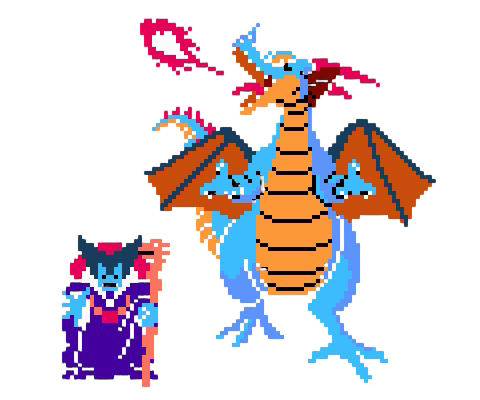
On December 1st 2015, according to GitHub, Thomas McGrew released the beta for DWRandomizer: an app that jumbles the contents of the seminal 1989 NES game that birthed the Japanese role-playing game: Dragon Warrior.
McGrew’s app uses the Chunsoft classic as a base on which to craft a somewhat new game – a tile set to shuffle into a game somewhat of your choosing. It can randomise virtually everything about Dragon Warrior: over world map, stats, enemies, drops, XP, enemy attack patterns, monster abilities – even the hero’s sprite is on the table here. Wander the 8-bit over world of Alefgard as a series-mascot slime or as the main character from classic Pokémon games or an NFL football player or a Final Fantasy character.
Yeah – it’s that random.
And just how random you want your adventure to be is entirely up to you: upload your Dragon Warrior US NES ROM to dwrandomizer.com, set how random you want Alefgard to be – such as “Shuffle Chest Locations” – download the modified ROM, and boot it in your favourite NES emulator. Computer-science magic ensures it’s notchaotically random, meaning you needn’t worry about missing items or locations. Each randomised iteration is always playable – if not always fun or easy.
But it is always nostalgic. The beeps and boops of the original Dragon Warrior capture the warm glow of a CRT after a slow day at school or a tough shift at work. They capture that nostalgia in the best possible way because it’s just so uncomplicated. Randomizer lets us bask in that glow forever without feeling the fatigue of the same old adventure. It lets us live in a world where Dragon Warrior is always an epic adventure no matter how many times you’ve slain the game’s big bad – like you’ve just picked up a release-day copy on the way home.

It turns the world of Dragon Warrior into something more akin to Dungeons & Dragons, with the randomizer settings acting as a would-be dungeon master. It literally builds the world you explore. That’s fitting, too, as Dragon Warrior was heavily inspired by early computer RPGs like Wizardry and Ultima — themselves directly influenced by Dungeons & Dragons.
What doesn’t change in randomisation is the game’s objective: obtain the Rainbow Drop to access Charlock Castle and defeat the Dragonlord within its depths to restore peace to Alefgard. The chain of items to get to Charlock Castle doesn’t change in DWRandomizer, but their locations do. You know what’s being randomised in any given run – but you don’t know how that randomisation has manifested in the world until it hits you square in the face.
Dragon Warrior is distinct in the JRPG pantheon for having just a single hero – no colourful cast of delinquents or outcasts, no long-winding cutscenes and dialogue. It lends itself to randomisation, then: a game that’s a selection of locations, spells, and sprites without a complex Shakespearian narrative to thread them together – there ain’t no sword-wielding athletes made of fireflies with daddy issues here. That diet narrative means its guts can be moved and mangled without worrying about continuity and cohesion.
The one-player party changes the game, too. You can’t attack with one party member then heal with another. You’ve got to time your actions around a single action per turn. No back-ups, no cross-party synergies. It’s all on you – the Dragon Warrior. If said warrior dies, you’re unceremoniously black-screened back to home base with half your gold gone.
You can see how it might make for a compelling, seat-of-pants esport. And it is – as demonstrated by a league that runs twice a year: once in winter, once in summer. Racers run the same randomised seed to see who navigates its randomness faster. The DWRandomizer YouTube channel chronicles the competition, with commentary that adds the sense that these people racing randomised, decades-old NES game are truly creating culture – turning something esoteric into an event worth tuning in for.

It’s a compelling example of emergent culture that, really, only video games can provide. Taking a 40-year-old game and re-arranging its guts for sport probably isn’t what artist Toriyama and developer Chunsoft envisioned back in the ’80s. But it speaks to just how resilient Dragon Warrior’s core formula is – it spawned a genre so beloved that 2025 darling Clair Obscure: Expedition 33 is celebrated for returning to a gameplay style birthed by Dragon Warrior all those years ago.
What I couldn’t understand was exactly where the skill comes in. Search ‘Dragon Warrior’ on Twitch, and you’ll occasionally find people practicing randomised runs. But it’s random – you can’t practice a particular route nor can you master a specific build or strategy for a specific fight. Each play through is just too different. After speaking with streamers in the scene as a viewer on Twitch, the skill comes from tracking where you’ve been, what you need, how much you need to grind to ensure you’re strong enough to fight the randomness to come – such as deciding which battles to flee to avoid investing in levels you don’t need.
There’s a real skill to it all. ‘Menuing’ is a speedrunning term for the ability to precisely and rapidly navigate menus, which can total up to minutes over the course of a run. Here, everything is a menu: opening a door is a menu, traversing the stairs is a menu, talking is a menu, opening a chest is a menu. Get the menu item wrong and valuable time is wasted.

My assessment of the scene: it’s brilliant. There’s something magical about preserving the hard work and ingenuity of a development team from 40 years ago. A new audience in a new age is preserving the work of Director Koichi Nakamura and co. decades later, even if it’s in a way they never intended nor could’ve comprehended. Some folk run on original NES hardware using an Everdrive cart. Others run the randomiser cooperatively, where both players share their experience, gold, gear, and various other bits via the power of computer-science magic.
It’s a special space that only games made before, say, the turn of the century can seemingly occupy. Those old classics – Mario 64, Dragon Warrior, Pokémon – were mostly made before then. Perhaps they mark a special intersection of nostalgia and technology that we’ll never quite see again in video game history: simple enough to be randomised, nostalgic enough for people to want to randomise them – no DLC, no online, and relatively little technical complexity.
I’ll continue to follow the scene for some time to come because it’s a small, shining light of hope in a miserable world overrun by microtransactions, layoffs, and subscription services. A group of people – not for profit, not for popularity, but purely for the love of the game – decided they want to make a game they love last forever.
And it’s that love that allows us to re-live a beloved experience as if it were a brand new adventure – just like we did in front of that CRT all those years ago.
Reply